


The Essential Pharmacology Guide for Nursing Students
The Essential Pharmacology Guide for Nursing Students
Color-coded drug class breakdowns, quick-check tables, and NCLEX-style practice questions that turn pharmacology from your hardest class into your strongest score.
Written by a Pediatric Nurse Practitioner — the exact frameworks nurses actually use, not another 1,000-page textbook you'll never finish.
Drug Class Breakdowns | Clinical Tips & Red Flags | NCLEX-Style Practice Questions | School, Clinicals & NCLEX Prep
Couldn't load pickup availability


Collapsible content
What's Inside (And Why You'll Actually Use It Before Your Next Exam)
What's Inside (And Why You'll Actually Use It Before Your Next Exam)
A complete, color-coded breakdown of every major drug class you'll be tested on — in school, in clinicals, and on the NCLEX — designed so you can find what you need in seconds, not scroll through 40 pages of dense text.
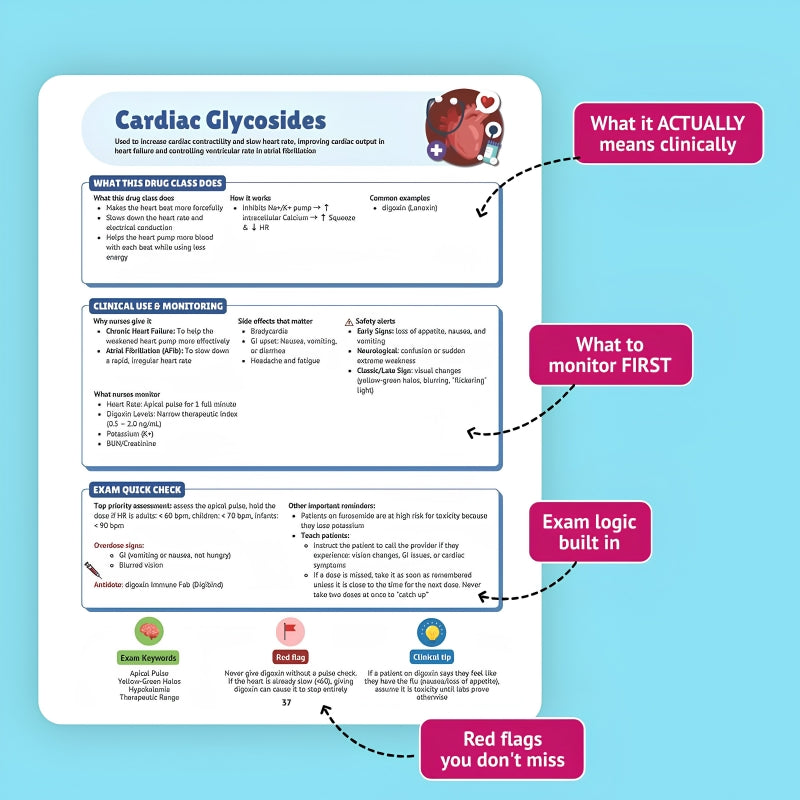
Most pharmacology textbooks bury the important stuff in paragraphs. This guide was built the opposite way: scannable first. Every drug class gets its own structured breakdown covering what the drug class does, how it works, clinical use and monitoring, side effects that actually matter, overdose signs and antidotes, and the specific "Exam Quick Check" and "Red Flag" callouts that show up on tests and in real patient care.
The guide includes dedicated sections for Pediatric "Never Give" Medications, Common Drug-Drug Interactions, and full NCLEX-style practice questions with complete rationales — so you're not just memorizing facts, you're learning to think through them the way an exam (and a real patient) will require.
Format: Full-color throughout, tabbed for fast reference, and organized so you can open to exactly the drug class you need. Use it for course prep, clinical rotations, or NCLEX review.
How to Use This Guide (It's Easier Than You Think)
How to Use This Guide (It's Easier Than You Think)
Find the drug class. Read the breakdown. Check the red flags. Done.
You don't need to re-read your entire textbook before an exam or a clinical shift. Every drug class is pre-organized so you can find exactly what you need — what it does, how it works, what to monitor, and what can go wrong — without digging through pages of unrelated information.
Most students keep it on their desk during pharmacology coursework, in their clinical bag during rotations, and open on the table during NCLEX review. There's no rigid order to work through it in — go class by class, or jump straight to whatever's on your next exam.
The NCLEX-style practice questions at the end of each section turn passive review into active recall — the kind of practice that actually shows up as a higher score on test day.
Heads up: Students consistently flag the "Never Give" and "Red Flag" callouts as the fastest way to catch the exact details professors and NCLEX questions love to test.
Why This One — When There Are So Many Pharm Guides on Amazon?
Why This One — When There Are So Many Pharm Guides on Amazon?
Fair question. Here's the honest answer:
Almost every other pharmacology resource for nursing students is either a 1,000-page textbook that assumes you have unlimited time, or a bare-bones cheat sheet that skips the reasoning you actually need for the NCLEX. Both leave you either overwhelmed or under-prepared.
This one is structurally different:
It's written by a practicing Pediatric Nurse Practitioner, not a generic content team. It's color-coded and tabbed for real scannability during clinicals, not just for reading at a desk. And it pairs every drug class with NCLEX-style questions and full rationales — so you build critical thinking, not just recall.
Think of it this way: dense textbooks are thorough but overwhelming. Bare-bones cheat sheets are fast but shallow. This guide is the bridge: the clinical depth of a textbook delivered with the speed and clarity of a cheat sheet.
That's why nursing students and instructors keep recommending it: it's accurate, it's fast to use, and it actually prepares you for the questions that show up on exams and in practice.
What Happens When Pharmacology Finally Clicks
96%
96% of students said a drug class finally clicked on the very first read — no re-reading three times needed.
91%
91% said they felt more confident answering questions during clinicals within the first week.
88%
88% bought a second copy for a study partner, cohort member, or incoming nursing student.

No More Blank Stares During Clinicals
You know the moment. Your preceptor asks why you can't abruptly stop corticosteroids, or what the risk is with aged cheese and MAOIs — and you freeze. You studied. You know the material is in there somewhere. But dense textbooks weren't built to be recalled under pressure, and one wrong answer feels like it could follow you. This guide does the thinking for you in advance — color-coded drug classes, clinical red flags, and the exact rationales behind them. You open the page. It clicks. No cramming required.

The Depth of a Textbook. The Speed of a Cheat Sheet.
Dense pharmacology textbooks are thorough but overwhelming — you spend more time finding the answer than learning it. Bare-bones cheat sheets are fast but shallow — they skip the rationale you need for the NCLEX and for real patient safety. Most students feel stuck choosing between the two. This guide is the bridge. Every major drug class broken down by what it does, how it works, what to monitor, and what can go wrong — color-coded and tabbed so you find it in seconds. Clinical accuracy. Scannable pages. A student who's finally ready.
Questions Nursing Students Ask Before Ordering
Is this written by someone qualified, or just another generic study guide?
Is this written by someone qualified, or just another generic study guide?
We get it — the market is flooded with rushed, low-effort study guides right now and it's hard to know what to trust.
This guide is written by Melissa Wynne, MSN, PNP, co-founder of Smart Edition Nursing and a practicing Pediatric Nurse Practitioner. Every drug class breakdown is grounded in real clinical practice, covers the core concepts you need for school, clinicals, and NCLEX prep, and is built around the frameworks nurses actually use at the bedside — not generic recycled content.
Look at the interior pages — you'll see the difference immediately. This isn't a wall of copied text. It's a purposeful, color-coded, tabbed guide built to help you find and understand what you need fast.
I'm just starting nursing school. Is this too advanced?
I'm just starting nursing school. Is this too advanced?
No — this was built to meet you where you are, from your first pharmacology course through the NCLEX.
Most pharmacology textbooks assume you already know the medical shorthand and bury the important details in paragraphs. This guide starts with what each drug class does and how it works in plain, structured terms, then builds up to the clinical monitoring and red flags you'll need in rotations.
You don't need to read it cover to cover before it's useful. Open to the drug class you're covering that week, read the breakdown, and use the NCLEX-style questions to check what actually stuck. Students consistently tell us it made pharmacology feel manageable for the first time — not less rigorous, just finally organized.
What if it doesn't help me?
What if it doesn't help me?
Then you don't pay. That's what the guarantee is for.
Every copy comes with a full 30-day money-back guarantee. Use it for your next exam, bring it into clinicals, see if it actually speeds up how you study. If it doesn't help for any reason, contact us and we'll take care of it. No hoops, no guilt, no fine print.
That said — students consistently tell us this is the resource they wish they'd had from day one of pharmacology. Going from re-reading dense chapters to scanning a color-coded breakdown changes how much you retain, and how fast you can review before a shift or an exam.
Does this actually cover NCLEX-style questions?
Does this actually cover NCLEX-style questions?
Yes. Every major section includes NCLEX-style practice questions with complete rationales — not just answer keys.
The goal isn't just to help you memorize facts, it's to help you critically think through the kind of scenario-based questions the NCLEX actually asks. Each rationale walks through why the correct answer is correct and why the others aren't, so you're building the reasoning skills that carry over into real clinical decision-making, not just test-day recall.
Is this tied to a specific nursing program or textbook?
Is this tied to a specific nursing program or textbook?
No. This guide covers the core pharmacology concepts that show up across nursing programs nationwide — drug classifications, mechanisms of action, clinical monitoring, side effects, interactions, and NCLEX-style application questions.
It's used by students in ADN, BSN, and accelerated nursing programs as a companion to whatever textbook or course material their school already assigns. If your program covers pharmacology, this guide will fit alongside it.