


My First Chemistry Adventure: A Fun Comic Guide for Kids Memorize Less.
My First Chemistry Adventure: A Fun Comic Guide for Kids Memorize Less.
500+ chemical knowledge points and over 1,000 full-color comic illustrations that turn real kitchen science into your kid's favorite screen alternative.
Created for kids who ask 'why' — real experiments, real explanations, zero memorization or dry formulas to force on them.
500+ Knowledge Points | 1,000+ Comic Illustrations | Real Experiments | Ages 5-15
Couldn't load pickup availability


Collapsible content
What's Inside (And Why Your Kid Will Actually Choose It Over Their Phone)
What's Inside (And Why Your Kid Will Actually Choose It Over Their Phone)
A full-color comic science book packed with 500+ chemical knowledge points and over 1,000 illustrations — built so kids stay hooked page after page instead of scrolling.
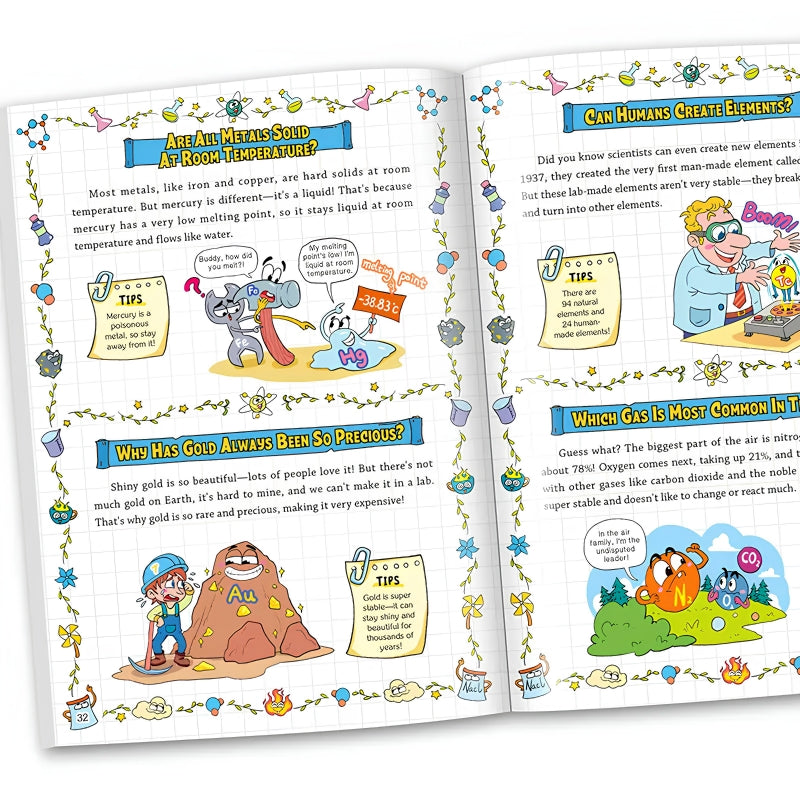
Most science books read like homework. This one was built the opposite way: curiosity first. Every chapter answers a real everyday question kids already wonder about — why onions make you cry, why metal rusts, why bread puffs up — through comic panels and simple, real kitchen experiments they can actually try.
There's no periodic table to memorize and no dry formulas to force on them. Just cause-and-effect science explained the way a curious kid's brain already wants to learn it.
Format: Large-format, full-color paperback with flexible binding, built for hands-on reading and easy re-reading at bedtime or on car rides.
How to Use This Book (There's No Wrong Way)
How to Use This Book (There's No Wrong Way)
Open to any page. Read the comic. Try the experiment if you want to. That's it.
There's no order to follow and nothing to study for. Some kids read it cover to cover in one sitting. Others keep it on the nightstand and flip to a random chapter each night. Either way, it works the same: one question, one comic explanation, one real 'aha' moment.
Parents consistently tell us the book becomes the thing their child reaches for during downtime that used to mean a phone or tablet — not because they were told to, but because the next chapter is genuinely more interesting.
Heads up: A few of the experiments use simple household items (milk, cola, water, an egg). None require special equipment, and most take under 5 minutes.
Why This One — When There Are So Many Kids' Science Books Out There?
Why This One — When There Are So Many Kids' Science Books Out There?
Fair question. Here's the honest answer:
Most kids' science books fall into one of two camps: dense encyclopedias that read like a textbook, or thin activity books with no real explanation behind the fun. Both lose a kid's attention fast.
This one is built differently:
It's told entirely through comic panels, not paragraphs, so kids stay engaged instead of skimming. It pairs every concept with a real experiment they can see or try, not just a diagram. And it's built around the questions kids are already asking, not a curriculum sequence written for a classroom.
Think of it this way: encyclopedias are thorough but boring. Activity books are fun but shallow. This book is the bridge — the depth of real science delivered with the pull of a comic they don't want to put down.
That's why parents keep passing it along to other parents: it's genuinely engaging, and it happens to be the screen-time alternative they've been looking for.
What Happens When Curiosity Finally Wins
96%
96% of parents said their child asked to read it again the very next day — without being told to.
91%
91% said their child chose the book over a phone or tablet at least once in the first week.
88%
88% bought a second copy for a sibling, cousin, or a friend's child.

No More Fighting Over Screen Time
You know the moment. It's the third time this week you've had to pry the phone out of their hands, and it always ends the same way — a fight nobody wins. Kids aren't wired to resist an endless feed of dopamine hits. They just need something that pulls at their curiosity just as hard. This book leads with real 'wait, how does that work?' moments — a color-changing drink, an egg that squeezes itself into a bottle, ice forming in seconds — then explains the real science behind it in a comic they actually want to finish. No arguing required. They put the phone down on their own.

The Wonder of a Lab. The Pull of a Comic Book.
Science encyclopedias are thorough but they lose kids by page two. Activity books are fun but they skip the actual explanation, so nothing sticks. Most parents feel stuck choosing between the two. This book is the bridge. Every everyday question — why yogurt tastes sour, why an onion stings your eyes, why bread rises — answered through full-color comic panels and a real experiment kids can watch or try themselves. Real science. Genuinely fun pages. A kid who wants to keep reading.
Questions Parents Ask Before Ordering
Is this actually educational, or just entertainment dressed up as a book?
Is this actually educational, or just entertainment dressed up as a book?
Both, honestly — that's the point.
The Wacky Chemistry Lab, written by Doris Walton, covers 500+ real chemical knowledge points across full-color comic chapters, each one built around an everyday question a kid would actually ask. Every comic pairs a real explanation with a real experiment they can picture or try at home.
Flip to any inside page and you'll see the difference immediately — it's not a wall of text pretending to be fun. It's built to be read for the story first, with the science landing naturally along the way.
My child is younger or older than average — will this still work for them?
My child is younger or older than average — will this still work for them?
Yes — it's built for a wide range, roughly ages 5 through 15.
Younger kids follow the comic panels and experiments visually even before they can read every word independently. Older kids get more out of the actual science explanations and the trickier concepts like non-Newtonian fluids and atmospheric pressure.
There's no set order to follow, so a child can start wherever grabs their attention and grow into the rest of the book over time rather than finishing it in one pass.
What if my kid doesn't get into it?
What if my kid doesn't get into it?
Then you don't pay. That's what the guarantee is for.
Every copy comes with a full 30-day money-back guarantee. Let them flip through it, try an experiment or two, see if it actually pulls their attention away from a screen. If it doesn't land for any reason, contact us and we'll take care of it. No hoops, no guilt, no fine print.
That said — most parents tell us the shift happens within the first few days, usually the moment their kid tries the first kitchen experiment themselves.
Do the experiments need adult supervision or special equipment?
Do the experiments need adult supervision or special equipment?
Most experiments use simple household items — milk, cola, water, salt, an egg, a glass bottle — nothing specialized. For younger kids, or any experiment involving heat, sharp objects, or small parts, we recommend doing it together with an adult nearby, both for safety and because it's genuinely more fun to share the reaction.
Plenty of chapters can simply be read as comics with no experiment at all — the book works either way.
Is this tied to a specific school curriculum?
Is this tied to a specific school curriculum?
No. This book isn't built around a classroom syllabus — it's built around the questions kids naturally ask about the world around them: why things rust, why bread rises, why an onion makes you cry.
It works as a standalone read at home, a screen-time alternative, or a supplement alongside whatever science your child is already covering in school.