


Murphy’s Law life principles for children:A comprehensive guide to benefit a lifetime
Murphy’s Law life principles for children:A comprehensive guide to benefit a lifetime
Nearly 100 real-life emotional intelligence lessons told through comic panels — the practical people-skills most kids never get taught.
Helps kids handle bullies, peer pressure, and unfair moments with confidence and a clear head, instead of tears or shutting down.
4-Volume Comic Series | 100+ Life Lessons | Real-Life Scenarios | Ages 6-16
Couldn't load pickup availability


Collapsible content
What's Inside (And Why Kids Actually Finish It Without Being Asked)
What's Inside (And Why Kids Actually Finish It Without Being Asked)
A 4-volume comic series covering nearly 100 real-life emotional intelligence and social strategy lessons — the kind of practical people-skills school doesn't usually teach.
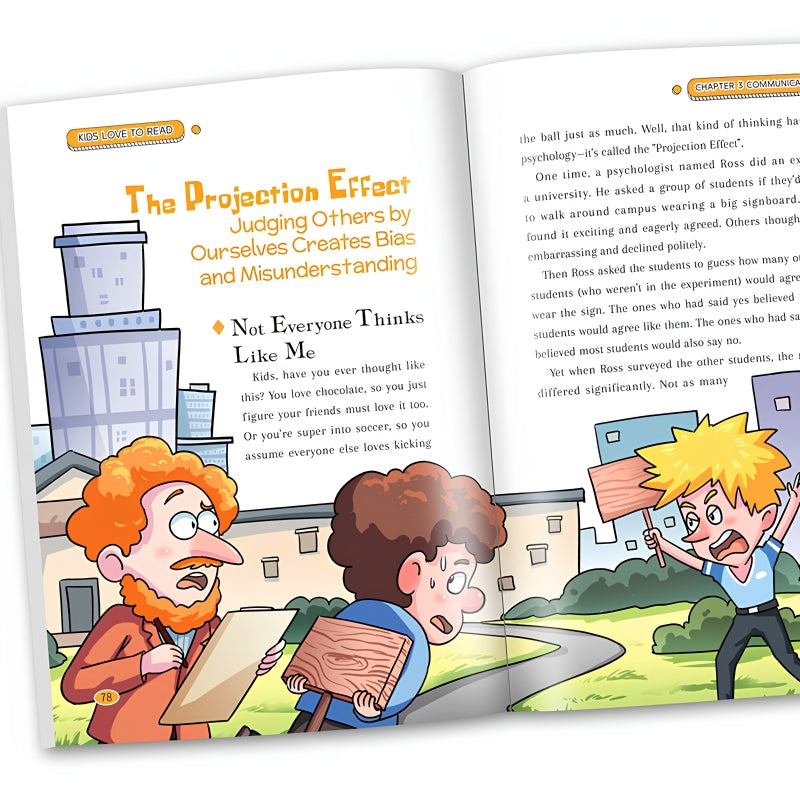
Most kids' character-building books lean on vague advice like 'be kind' or 'work hard.' This series goes further: each chapter takes a real behavioral concept — the Reciprocity Principle, the Herd Effect, the Confidence Rule, the Primacy Effect — and turns it into a comic scenario a kid can actually picture themselves in, followed by a plain-language 'Wisdom Booster' and 'Real-Life Wisdom' takeaway.
The goal isn't to make kids distrust the adults around them — it's to give them practical tools they can reach for in the moment: how to stay calm when criticized, how to spot when they're being pressured by a group, how to speak up for themselves clearly and confidently.
Format: Full-color comic panels across 4 volumes, organized by behavioral theme, with side-margin callouts for quick reference.
How to Use This Series (There's No Wrong Way)
How to Use This Series (There's No Wrong Way)
Pick a volume. Read a chapter. Talk about it if you want to. Done.
There's no required order and nothing to memorize. Some kids read a full volume in one sitting because the comic format pulls them through it. Others keep it by the bed and read one chapter before school, especially before a day they're nervous about.
Many parents use a chapter as a natural conversation starter after something happens at school — a disagreement with a friend, a tough moment with a teacher, a group project gone sideways. The comic gives both of you a shared example to talk through together, rather than starting the conversation cold.
Heads up: The "Tips" and "Wisdom Booster" callouts in the margins are the fastest way to get the takeaway from a chapter without reading every panel.
Why This One — When There Are So Many 'Life Skills' Books for Kids?
Why This One — When There Are So Many 'Life Skills' Books for Kids?
Fair question. Here's the honest answer:
Most kids' character books focus on general values — honesty, kindness, effort — without giving a kid an actual framework for handling a hard moment in real time. Others go the opposite direction and read like a dry psychology textbook translated for children.
This series sits in between:
It's written by Doris Walton and told almost entirely through comic scenarios, not lecture-style paragraphs, so kids stay engaged instead of skimming. Each concept is paired with a real scenario — handling an unfair accusation, managing a group of friends, staying steady under pressure — not just an abstract rule.
Think of it this way: values-only books are well-meaning but vague. Straight psychology books are accurate but dry. This series is the bridge — real behavioral concepts delivered through a comic kids actually want to keep reading.
What Happens When Kids Get Real Tools, Not Just Rules
96%
96% of parents said their child brought up a chapter on their own after a hard day at school.
91%
91% said their child handled a disagreement or criticism more calmly within a few weeks.
88%
88% bought the full series or an extra set for a sibling, cousin, or friend's child.

"Be Good and Work Hard" Isn't a Full Toolkit
You raise them to be kind, obedient, hardworking — and then a classmate spreads a rumor, or a group of kids leaves them out, and none of that prepares them for the moment. Being a good kid and knowing how to handle a hard social situation are two different skills, and most upbringing only covers the first one. This series gives kids a third option beyond 'freeze up' or 'lash out': real, practical ways to think clearly under pressure, stand up for themselves calmly, and read a situation before it escalates. You're not there in the hallway. This gives them something to reach for when you can't be.

The Depth of a Psychology Book. The Speed of a Comic.
Straight-up psychology books are accurate but dry — most kids won't get past the first chapter. Generic 'be a good friend' books are easy to read but don't give a kid anything concrete to do when things actually get hard. Most parents feel stuck between the two. This series is the bridge. Real behavioral concepts — the Reciprocity Principle, the Herd Effect, the Confidence Rule — delivered through comic scenarios a kid can actually picture themselves in. Real substance. Genuinely engaging pages. A kid who finishes the book instead of shelving it.
Questions Parents Ask Before Ordering
Is this actually teaching real psychology, or is it just entertainment?
Is this actually teaching real psychology, or is it just entertainment?
Both — that's the point.
The Scarily Accurate Caricature: Murphy's Law, written by Doris Walton, walks through nearly 100 real behavioral and emotional-intelligence concepts across its 4 volumes — things like the Reciprocity Principle, the Herd Effect, and the Confidence Rule — each one told through a comic scenario a kid can actually relate to, followed by a plain-language takeaway.
Flip to any inside page and you'll see the structure immediately: comic panel first, "Wisdom Booster" and "Real-Life Wisdom" callouts in the margin. It's built to be read for the story, with the concept landing naturally alongside it.
My child is younger or older than average — will this still work?
My child is younger or older than average — will this still work?
Yes — the series is built for a wide range, roughly ages 6 through 16.
Younger kids connect with the comic scenarios and the simpler chapters on confidence and friendship. Older kids get more out of the chapters on peer pressure, first impressions, and handling conflict or unfair situations.
There's no required order, so a child can start with whatever chapter matches something they're currently dealing with, rather than working through the series front to back.
What if it doesn't help my child?
What if it doesn't help my child?
Then you don't pay. That's what the guarantee is for.
Every order comes with a full 30-day money-back guarantee. Let your child read through a volume or two, see whether the scenarios and takeaways actually resonate. If it doesn't for any reason, contact us and we'll take care of it. No hoops, no guilt, no fine print.
Most parents tell us the shift shows up in small moments first — their kid mentioning a chapter after school, or handling a disagreement a little more calmly than before.
Does this encourage kids to ignore their teachers or parents?
Does this encourage kids to ignore their teachers or parents?
No — it's the opposite. The series teaches kids to think critically, stay calm under pressure, and stand up for themselves in the moment, while still encouraging them to talk to a trusted adult when something feels wrong or too big to handle alone.
The goal is giving kids their own first line of defense for everyday social situations — not replacing the adults in their life, but making sure they're not defenseless in the gap before an adult can step in.
Is this tied to a specific school curriculum?
Is this tied to a specific school curriculum?
No. This series isn't built around a classroom syllabus — it's built around real social situations kids run into: bullying, peer pressure, unfair blame, group dynamics, and building genuine friendships.
It works as a standalone read at home, a conversation-starter after a rough day, or a companion to whatever social-emotional learning your child's school already covers.